CSAW [see-SAH] is the most comprehensive student-run cyber security event in the world, featuring 10 hacking competitions, workshops, and industry events. CSAW’21 marks the 7th anniversary of CSAW MENA (Middle East North Africa) organized by NYU Abu Dhabi and Center for Cyber Security. it will be a virtual event from November 10th to 14th, 2021.
The “dragonfly handshake”—a nickname for a wi-fi security protocol thought to provide strong protection from hacking—may not be as firm as previously thought. Two security researchers, Mathy Vanhoef of NYU Abu Dhabi and Eyal Ronen of Tel Aviv University, have found that the WPA-3 protocol can indeed by breached, despite claims that its method of authentication, called Simultaneous Authentication of Equals (SAE), would make passwords almost impossible to crack. The researchers, who won a Pwnie Cryptography Award in 2019 and garnered press coverage in Forbes Magazine, ZDNet, and others, identified “severe vulnerabilities in all implementations,” and revealed “side-channels that enable offline dictionary attacks.” Vanhoef, who is affiliated with the Center for Cybersecurity at NYU Abu Dhabi, and his colleague recently presented a paper on this work at the IEEE Security and Privacy Conference, one of five CCS-affiliated presentations delivered at the 2020 S&P Conference.
A team led by researchers at NYU Tandon discover that credibility indicators flagging spurious headlines can reduce intention to share non-true news, though demographics and political affiliation influence their effectiveness
BROOKLYN, New York, Tuesday, April 28, 2020 – The dissemination of fake news on social media is a pernicious trend with dire implications for the 2020 presidential election. Indeed, research shows that public engagement with spurious news is greater than with legitimate news from mainstream sources, making social media a powerful channel for propaganda.
A new study on the spread of disinformation reveals that pairing headlines with credibility alerts from fact-checkers, the public, news media and even AI, can reduce peoples’ intention to share. However, the effectiveness of these alerts varies with political orientation and gender. The good news for truth seekers? Official fact-checking sources are overwhelmingly trusted.
The study, led by Nasir Memon, professor of computer science and engineering at the New York University Tandon School of Engineering and Sameer Patil, visiting research professor at NYU Tandon and assistant professor in the Luddy School of Informatics, Computing, and Engineering at Indiana University Bloomington, goes further, examining the effectiveness of a specific set of inaccuracy notifications designed to alert readers to news headlines that are inaccurate or untrue.
Fact Checkers: “Multiple fact-checking journalists dispute the credibility of this news”
News Media: “Major news outlets dispute the credibility of this news”
Public: “A majority of Americans disputes the credibility of this news”
AI: “Computer algorithms using AI dispute the credibility of this news”
“We wanted to discover whether social media users were less apt to share fake news when it was accompanied by one of these indicators and whether different types of credibility indicators exhibit different levels of influence on people’s sharing intent,” says Memon. “But we also wanted to measure the extent to which demographic and contextual factors like age, gender, and political affiliation impact the effectiveness of these indicators.”
Participants — over 1,500 U.S. residents — saw a sequence of 12 true, false, or satirical news headlines. Only the false or satirical headlines included a credibility indicator below the headline in red font. For all of the headlines, respondents were asked if they would share the corresponding article with friends on social media, and why.
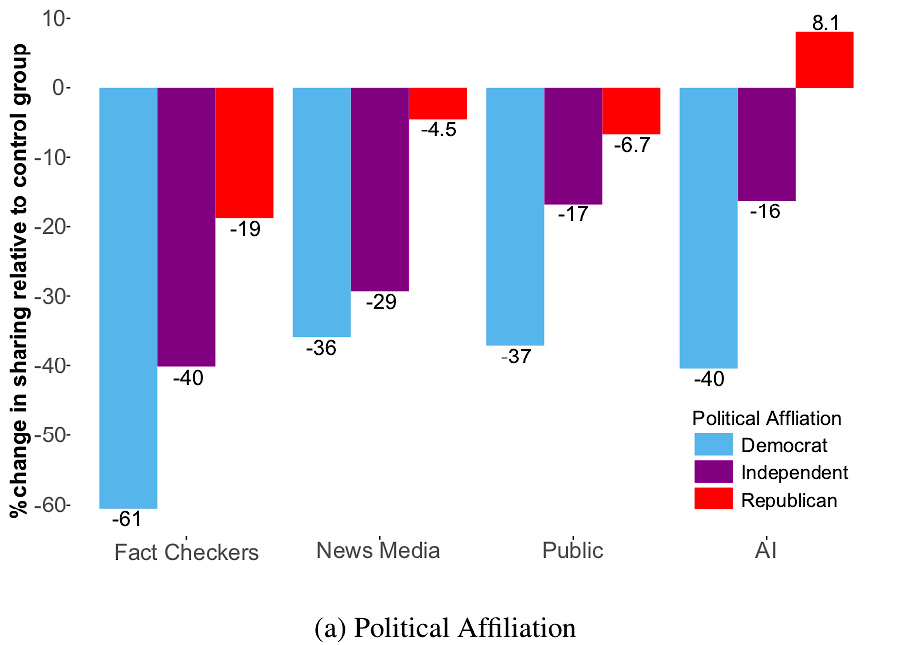
“Upon initial inspection, we found that political ideology and affiliation were highly correlated to responses and that the strength of individuals’ political alignments made no difference, whether Republican or Democrat,” says Memon. “The indicators impacted everyone regardless of political orientation, but the impact on Democrats was much larger compared to the other two groups.”
The most effective of the credibility indicators, by far, was Fact Checkers: Study respondents intended to share 43% fewer non-true headlines with this indicator versus 25%, 22%, and 22% for the “News Media,” “Public,” and “AI” indicators, respectively.
Effects of Political Affiliation
The team found a strong correlation between political affiliation and the propensity of each of the credibility indicators to influence intention to share. In fact, the AI credibility indicator actually induced Republicans to increase their intention to share non-true news:
Democrats intended to share 61% fewer non-true headlines with the Fact Checkers indicator (versus 40% for Independents and 19% for Republicans)
Democrats intended to share 36% fewer non-true headlines with the News Media indicator (versus 29% for Independents and 4.5% for Republicans)
Democrats intended to share 37% fewer non-true headlines with the Public indicator, (versus 17% for Independents and 6.7% for Republicans)
Democrats intended to share 40% fewer non-true headlines with the AI indicator (versus 16% for Independents)
Republicans intended to share 8.1% more non-true news with the AI indicator
Republicans are less likely to be influenced by credibility indicators, more inclined to share fake news on social media.
Patil says that while fact-checkers are the most effective kind of indicator, regardless of political affiliation and gender, fact-checking is a very labor-intensive. He says the team was surprised by the fact that Republicans were more inclined to share news that was flagged as not credible using the AI indicator.
“We were not expecting that, although conservatives may tend to trust more traditional means of flagging the veracity of news,” he says, adding that the team will next examine how to make the most effective credibility indicator — fact-checkers — efficient enough to handle the scale inherent in today’s news climate.
“This could include applying fact checks to only the most-needed content, which might involve applying natural language algorithms. So, it is a question, broadly speaking, of how humans and AI could co-exist,” he explains.
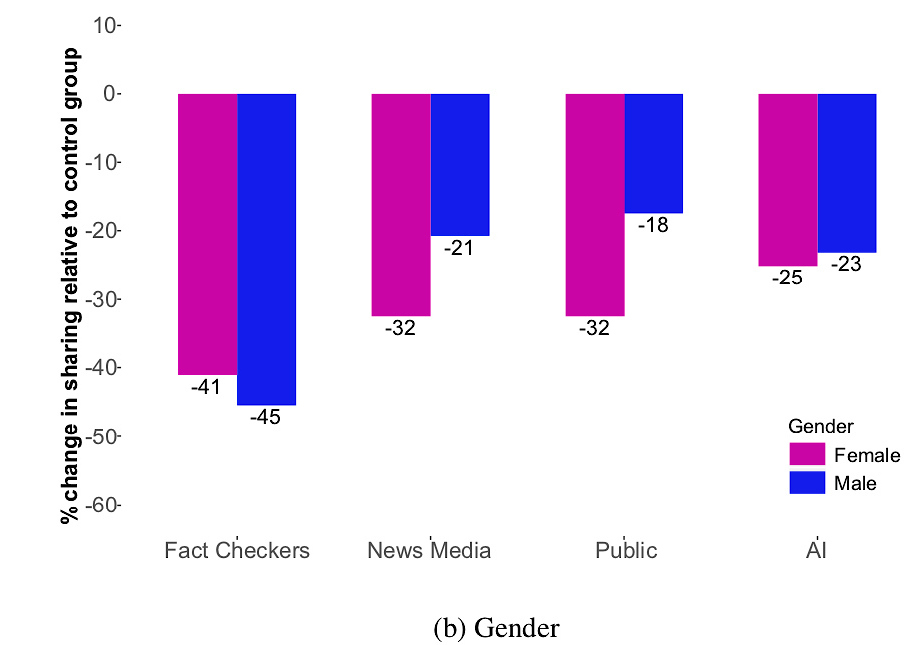
The team also found that males intended to share non-true headlines one and half times more than females, with the differences largest for the Public and News Media indicators.
Men are less likely to be influenced by credibility indicators, more inclined to share fake news on social media.But indicators, especially those from fact-checkers, reduce intention to share fake news across the board.
Socializing was the dominant reason respondents gave for intending to share a headline, with the top-reported reason for intending to share fake stories being that they were considered funny.
“Effects of Credibility Indicators on Social Media News Sharing Intent” is available at: ACM Digital Library
About the New York University Tandon School of Engineering
The NYU Tandon School of Engineering dates to 1854, the founding date for both the New York University School of Civil Engineering and Architecture and the Brooklyn Collegiate and Polytechnic Institute (widely known as Brooklyn Poly). A January 2014 merger created a comprehensive school of education and research in engineering and applied sciences, rooted in a tradition of invention and entrepreneurship and dedicated to furthering technology in service to society. In addition to its main location in Brooklyn, NYU Tandon collaborates with other schools within NYU, one of the country’s foremost private research universities, and is closely connected to engineering programs at NYU Abu Dhabi and NYU Shanghai. It operates Future Labs focused on start-up businesses in downtown Manhattan and Brooklyn and an award-winning online graduate program. For more information, visit engineering.nyu.edu.
World’s largest technical professional association honors Ramesh Karri for contributions to securing the supply chain for electronic design and manufacturing. His recent pioneering work addresses 3D printing, nano-scale biochips
BROOKLYN, New York, February 4, 2020 – New York University School of Engineering Professor Ramesh Karri has been named a fellow of the Institute of Electrical and Electronics Engineers (IEEE), the world’s largest technical professional association, for his contributions to and leadership in trustworthy electronic hardware.
Karri is a professor of electrical and computer engineering at NYU Tandon, co-founder and co-chair of the NYU Center for Cyber Security, and faculty leader for the world’s most comprehensive student-led cybersecurity games, CSAW (Cyber Security Awareness Worldwide).
Karri, who has more than 250 journal and conference publications to his credit, was recognized for his seminal work in ensuring that the global hardware supply chain is as secure as possible. Hardware security is an especially great concern in an age when chips are being manufactured at supplier foundries far from where they are designed, giving bad actors ample opportunity to install malicious “Trojan horse” circuits or to pirate intellectual property. Vulnerabilities in the chain threaten not only personal computers and smartphones but automotive systems, major utilities, the aerospace industry, nuclear facilities, and industrial equipment.
Karri is widely acknowledged for bringing the need for strong hardware security to the attention of the industry and for placing NYU Tandon at the forefront of the vital field. In 2002 he and his colleagues generated the first research on attack-resilient chip architecture, demonstrating before anyone else that integrated circuits’ test and debug ports could be used by hackers. Since then, he pioneered the technique of microchip camouflaging, a tactic to prevent reverse engineering; delivered the first set of invited IEEE tutorials in hardware security in the U.S., Europe, and Latin America; presented the first research paper on split manufacturing, a means of thwarting counterfeiting by an untrusted foundry by dividing a chip’s blueprint into several components and distributing each to a different fabricator; explored the vulnerabilities in digital microfluidic biochips, which are used by researchers and medical professionals for diagnostics, DNA sequencing, and environmental monitoring; and more.
Some of his latest research involves the growing additive manufacturing (3D-printing) industry, whose use of computer-aided design (CAD) files leaves it subject to threats like viruses and piracy.
Karri is also well-known in the hardware security world for founding the Embedded Security Challenge, which is held each year as part of CSAW. Research developed during the contest has propelled the entire field of hardware trust, and several students who have participated in the challenge, which was inaugurated in 2008, have gone on to make important contributions to the field. The challenge was foundational in the establishment of a National Science Foundation-supported network called Trust-Hub, an open and collaborative digital clearinghouse and community-building site where researchers exchange papers, hardware platforms, source codes, and tools.
“I heartily congratulate Professor Karri on taking his well-deserved place as an IEEE fellow,” said Dean Jelena Kovačević. “The honor is indicative of the pioneering nature and importance of his research, which has helped make NYU Tandon a leader in a field exceptionally important to the security of the world’s cyber systems.”
In addition to his IEEE Fellowship, Karri is the recipient of a Humboldt Fellowship and a National Science Foundation CAREER Award. His work has been funded by the Office of Naval Research, the Defense Advanced Research Projects Agency (DARPA), the Army Research Office, the Air Force Research Laboratory, the Semiconductor Research Corporation, and companies including Boeing, Intel, Ford, and Cisco.
37th IEEE International Conference on Computer Design (ICCD 2019) took place at New York University Abu Dhabi (NYUAD). November 17 – 20, 2019.
The IEEE International Conference on Computer Design encompasses a wide range of topics in the research, design, and implementation of computer systems and their components. ICCD’s multi-disciplinary emphasis provides an ideal environment for developers and researchers to discuss practical and theoretical work covering systems and applications, computer architecture, verification and test, design tools and methodologies, circuit design, and technology.