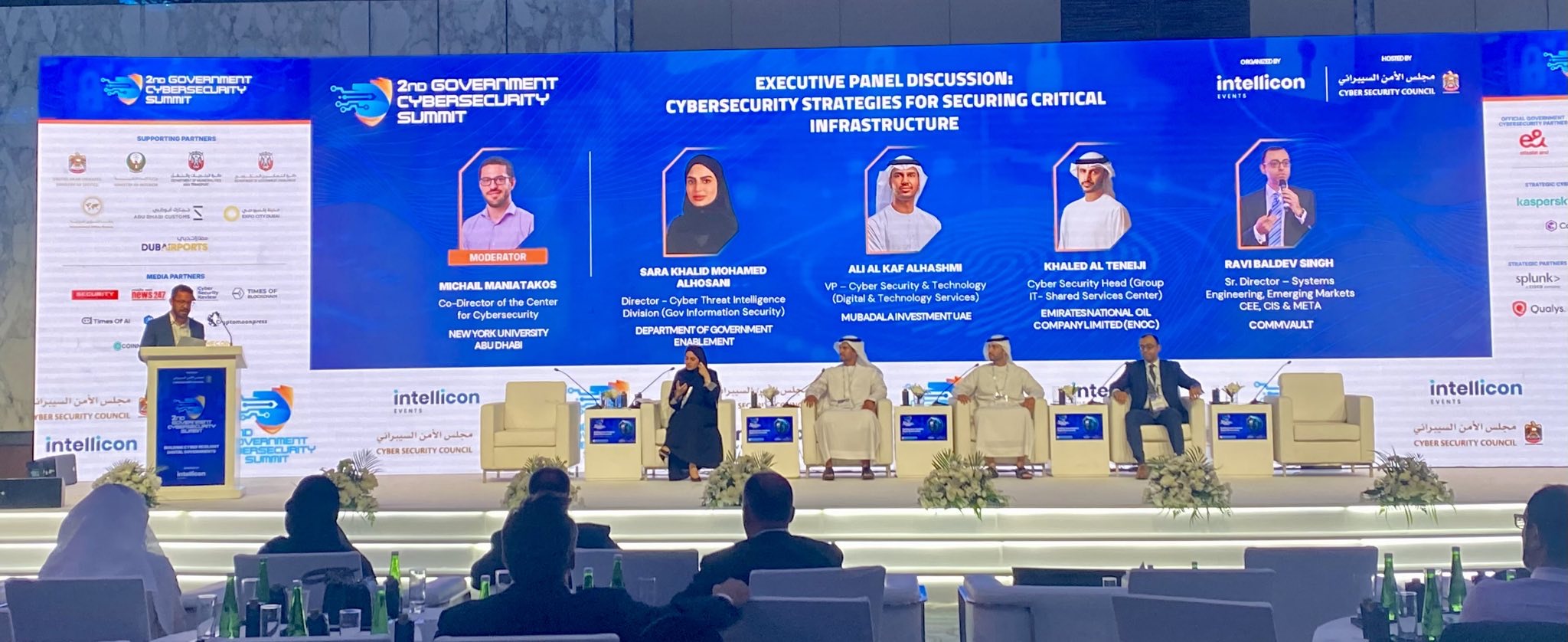
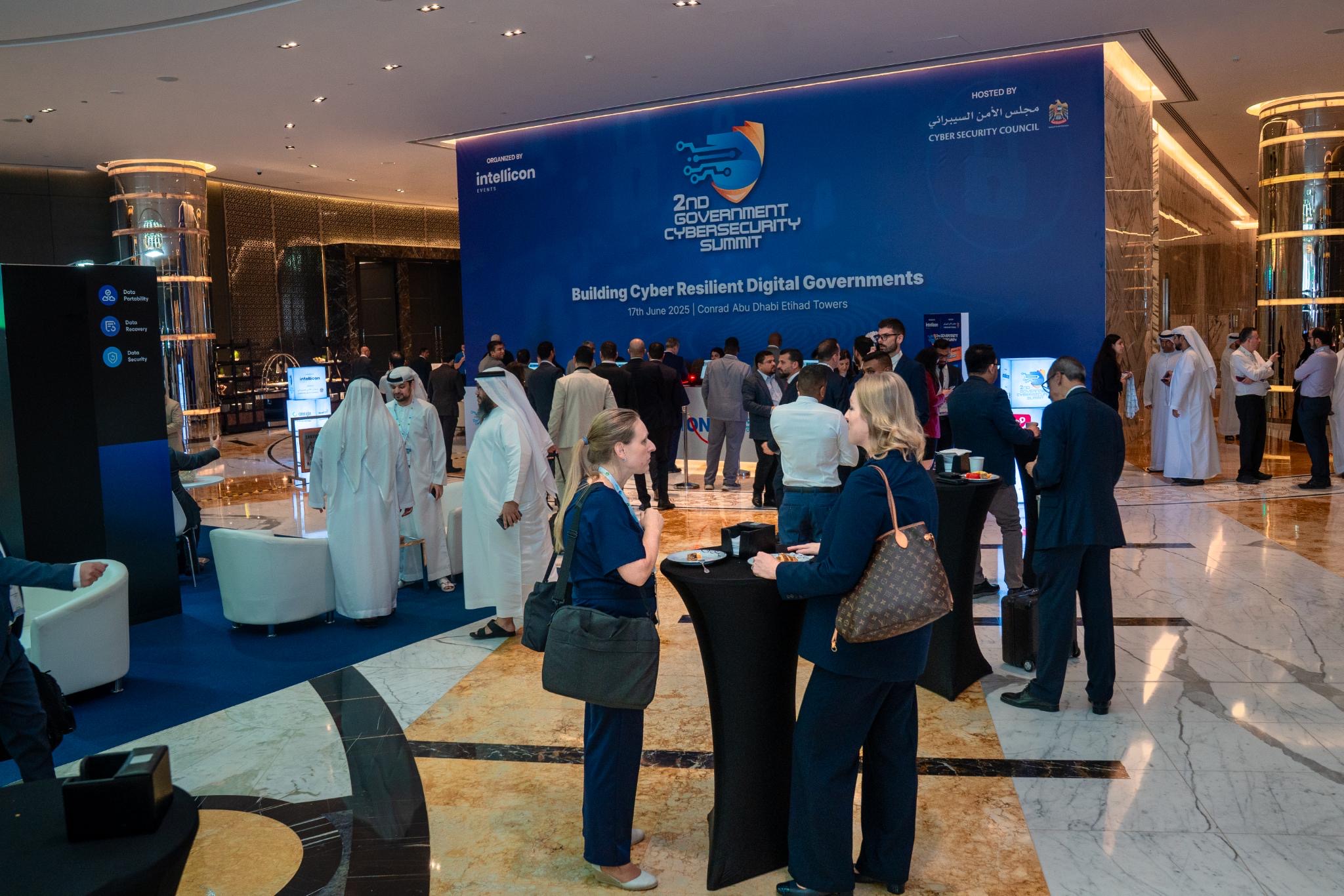
The Center for Cybersecurity at NYU Abu Dhabi is proud to highlight Michail Maniatakos, Co-PI, for moderating an Executive Panel Discussion hosted by the UAE Cybersecurity Council. The session focused on strategies to safeguard critical infrastructure from cyber threats.
Key topics discussed included:
Risk assessment and threat intelligence to identify and mitigate cyber threats
24/7 monitoring systems for real-time incident detection and response
Best practices for protecting vital national infrastructure
Panelists included:
Sara Khalid Mohamed Alhosani, Director, Cyber Threat Intelligence Division, Department of Government Enablement
Ali Al Kaf Alhashmi, Vice President, Cyber Security and Technology, Mubadala Investment UAE
Khaled Al Teneiji, Cyber Security Head, Group IT- Shared Services Center, Emirates National Oil Company Limited (ENOC)
Ravi Baldev Singh, Senior Director, Systems Engineering, Emerging Markets CEE, CIS & META, Commvault
The discussion underscored the UAE’s dedication to strengthening national cybersecurity and highlighted the Center for Cybersecurity’s role in shaping thought leadership in the field.
Christina Popper, Associate Professor of Computer Science at NYU Abu Dhabi and Co-Principal Investigator at our Center for Cyber Security, recently appeared on the World Police Summit podcast to discuss her research and passion for cybersecurity.
During the interview, Christina explored how her work at NYUAD, from designing secure systems to protecting privacy and addressing emerging digital threats, directly relates to the real-world challenges faced by law enforcement and security professionals worldwide. She also emphasized the critical role of collaboration between academia, industry, and public safety organizations, highlighting how this aligns closely with the Summit’s mission.
This insightful conversation underscores Christina’s dedication to making the digital world safer and reflects the impact our team aims to achieve every day.
Prof. Ozgur Sinanoglu and his team have won the IEEE Transactions on Emerging Topics in Computing Best Paper Award.
M. Yasin, B. Mazumdar, O. Sinanoglu and J. Rajendran, “Removal Attacks on Logic Locking and Camouflaging Techniques,” IEEE Transactions on Emerging Topics in Computing, vol. 8, no. 2, pp. 517- 532, April-June 2020, doi: 10.1109/TETC.2017.2740364
Modern Machine Learning (ML) approaches like Deep Neural Networks (DNNs) have shown tremendous improvement over the past years to achieve a significantly high accuracy for a certain set of tasks, like image classification, object detection, natural language processing, and medical data analytics. However, these DNN require huge processing, memory, and energy costs, besides being vulnerable to several security threats. This talk will present challenges and cross-layer frameworks for building highly energy-efficient and robust machine learning systems for the tinyML and EdgeAI applications, which jointly leverage optimizations at different software and hardware layers, e.g., neural accelerator, memory access optimizations, approximations, hardware-aware NAS and network compression. These cross-layer techniques enable new opportunities for improving the area, power/energy, and performance efficiency of systems by orders of magnitude, which is a crucial step towards enabling the wide-scale deployment of resource-constrained embedded AI systems like UAVs, autonomous vehicles, Robotics, IoT-Healthcare / Wearables, Industrial-IoT, etc.
Graph Neural Networks (GNNs) have shown great success in learning on graph-structured data, such as social networks, recommendation systems, and protein-protein interactions. In our work, we leverage the fact that circuits can be represented naturally as graphs and we employ GNNs to learn the properties of circuits. Through our graph-based learning on circuits, we are able to identify critical security vulnerabilities in the implementations of various design-for-trust solutions aimed to achieve hardware security.
The construction industry is shifting towards digitalization and automation (known as Construction 4.0), impacting the different phases of construction projects, from planning to design to construction and operation. This shift includes creating, editing, storing, and sharing information in digital environments and monitoring and controlling site activities by utilizing (semi)autonomous robotic systems and remote-controlled machines. Although this transformation is very exciting and promising, it also makes the construction sector a vulnerable target for cyber-attacks and raises many questions about privacy and security concerns. With the support from the CCS-AD, researchers from the S.M.A.R.T. Construction Research Group at NYUAD, led by Prof. Borja García de Soto, investigate some of the cybersecurity implications of Construction 4.0.